
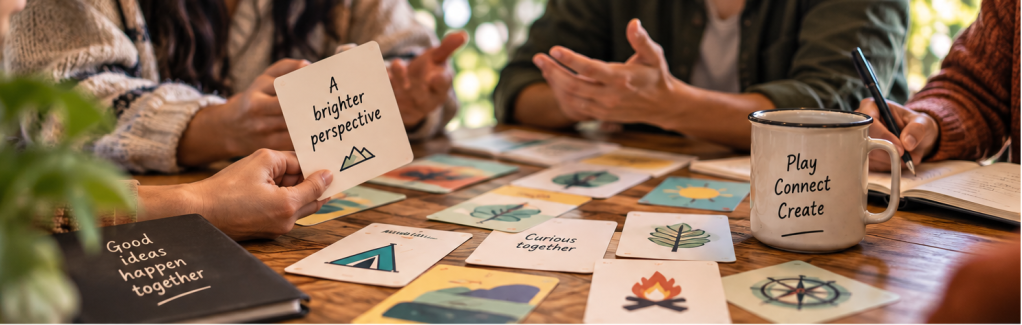
A lot of learning starts with a familiar question:
What do people need to know?
It’s an important question. But it can also lead us very quickly towards information such as explanations, presentations, readings, videos and slides.
At Ideation Games, we’re interested in another question:
What could people do with the idea?
That small shift changes the way we think about learning.
Instead of only asking how information should be presented, we can start thinking about experiences: something to explore, a decision to make, a problem to solve, an object to create, a perspective to consider or a conversation to have.
Learning isn’t only about receiving information
Information matters. Sometimes the clearest and most useful thing we can do is simply explain something well.
But knowing about an idea and engaging with it are different experiences.
Imagine learning about community development by reading about community assets, challenges and opportunities.
Now imagine sitting around a table with other people, encountering those ideas through a game. You have to make choices. Someone interprets a situation differently from you. A card prompts a conversation you hadn’t expected. An idea emerges from the group.
The content may be similar.
The experience isn’t.
And sometimes it is the experience that gives the content meaning.
Play creates something to respond to
One of the things we find interesting about games is that they give people something external to interact with.
- A card can ask the awkward question.
- A scenario can introduce the problem.
- A game mechanic can create uncertainty.
- A shared task can give people a reason to talk to one another.
That matters because participation doesn’t always happen simply because we ask for it.
- “Any thoughts?”
- “Who would like to share?”
- “Let’s discuss.”
Anyone who has facilitated a group knows what can follow: silence.
A well-designed activity gives people something more concrete to respond to. The conversation is no longer starting from nothing.
The game isn’t the learning
This distinction is important.
Adding a game to a session doesn’t automatically make the experience meaningful. Play can be entertaining without producing much reflection at all.
The design question is not simply:
How can we make this fun?
It is:
What kind of thinking, conversation or discovery do we want the experience to make possible?
That might mean:
- noticing something
- questioning an assumption
- hearing another perspective
- trying an idea
- making a connection
- leaving with a question that continues after the activity ends.
The game is not necessarily the destination. Sometimes it is the structure that helps people get somewhere interesting together.
From game to conversation
This thinking influenced the development of Camp Venture, our community-development board game.
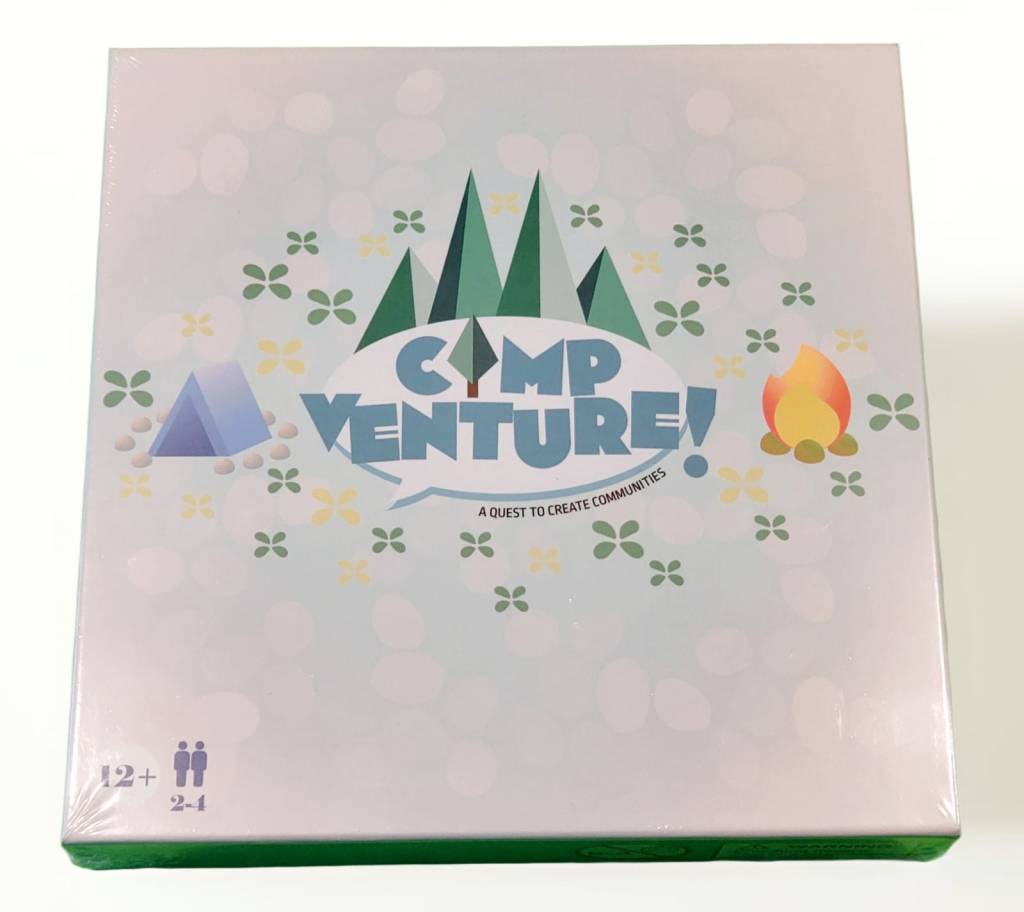
Players journey from base camp towards a grand campfire, encountering community assets, challenges and opportunities along the way.
But reaching the campfire isn’t really the most interesting part.
What matters is what happens around the board: the ideas people contribute, the different perspectives that emerge and the conversations prompted by the journey.
That’s why we think of Camp Venture not simply as a board game, but as a way of creating a shared experience around ideas that might otherwise be introduced as information.
Designing for what happens between people
Perhaps this is the part of play that interests us most.
When we design learning, we often focus on the relationship between the content and the learner.
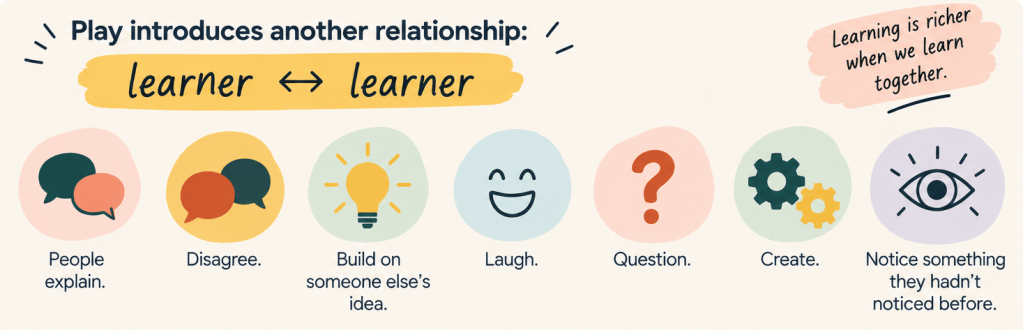
Not every learning experience needs a game. And not every subject should be turned into one.
But when the goal involves exploration, creativity, reflection or multiple perspectives, it can be worth asking a different question:
Instead of only telling people about this, what experience could we create around it?
That question is at the heart of what we’re exploring at Ideation Games.
A question to play with
Think about something you currently teach, explain or facilitate.
If you removed the presentation, what could people do instead?
 Ideation Games